|
Merve Kocabas
I am a Master’s student in Machine Learning at the University of Tübingen, working with Prof. Andreas Geiger in the Autonomous Vision Group. I am currently a visiting student at the Georgia Institute of Technology, where I work with Prof. Sara Fridovich-Keil in the VOILA Lab. My studies are supported by the ELIZA Master Scholarship, and my master’s thesis is supported by PROMOS scholarship. Before my master’s studies, I completed my undergraduate education at Middle East Technical University, where I studied Computer Engineering and Aerospace Engineering.
I am always happy to connect, so feel free to reach out!
Email
/
Github
/
LinkedIn
/
Google Scholar
|

|
|
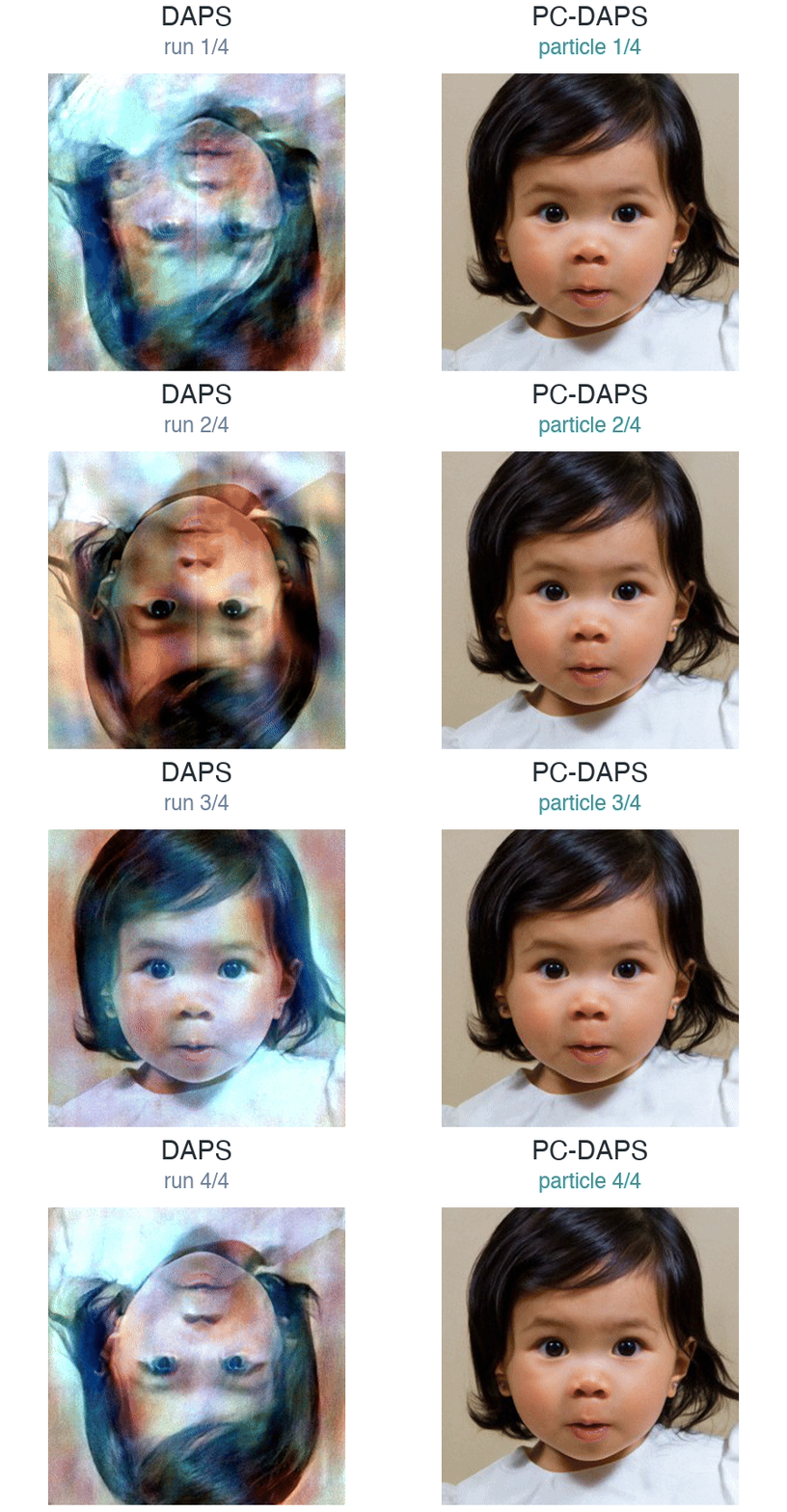
Beyond Best-of-k: Prior-Consistent DAPS for Ambiguous Nonlinear Inverse Problems
Merve Kocabas*,
Benjamin A. Burns*,
Andreas Geiger,
Kent Gauen,
Sara Fridovich-Keil
Preprint, 2026
[Paper]
[PC-DAPS project page]
[Code]
[Abstract]
Abstract:
Diffusion models have become strong priors for solving inverse problems. However, nonlinear inverse problems such as phase retrieval remain challenging when multiple measurement-consistent solutions are distinguishable only by the prior; we call such measurements ambiguous. Existing diffusion-based samplers rely on local approximations during reconstruction. For an ambiguous measurement, these approximations can allow measurement guidance to favor a measurement-consistent mode that is close to a prior-supported mode but is itself not supported by the prior. Evaluation often masks this type of failure by reporting the best-of-k runs, where the best is selected by comparison to the ground truth. We introduce Prior-Consistent DAPS (PC-DAPS), a variant of Decoupled Annealing Posterior Sampling (DAPS) designed to address this failure case by maintaining multiple candidate solutions within a single sampling run. As annealing noise decreases, PC-DAPS prunes and replaces weaker candidates according to their prior consistency, without any ground-truth access. PC-DAPS reduces the incidence of prior-inconsistent samples and improves sample quality on nonlinear inverse problems while preserving sample quality and diversity on linear inverse problems.
|

|
Trajectory Forcing: Structure-First Generation with Controllable Semantic Trajectories
Merve Kocabas,
Gege Gao,
Bernhard Schölkopf,
Andreas Geiger
ECCV, 2026
[Paper]
[Trajectory Forcing project page]
[Code]
[Abstract]
Abstract:
Diffusion and flow-based generative models typically treat generation as an opaque mapping from noise to image. Although recent methods have begun to exploit trajectory structure for improved quality, intermediate states remain uninterpretable and inaccessible to users. We propose Trajectory Forcing (TF), a framework that elevates the generative trajectory from a hidden computational process to an explicit, controllable object. Generation is organized as a sequence of semantically structured stages, progressing from global layout through object-level parts to fine-grained detail, where every intermediate state can be decoded, inspected, and edited. We construct coarse-to-fine teacher hierarchies via unsupervised clustering in pretrained, semantically meaningful representation spaces (e.g., DINOv2), and train a hierarchy-conditioned model using one-step flow matching at each level. We further introduce trajectory-aware evaluation measures that quantify structural consistency and local controllability beyond standard metrics such as FID. Experiments show that TF achieves competitive sample quality while producing structurally coherent, decodable intermediate states that support localized editing at each semantic level. By shifting the modeling focus from the final model outputs to generative dynamics, Trajectory Forcing enables controllable, trajectory-aware image synthesis.
|
|